Showing posts with label review. Show all posts

Sunday, 28 September 2014

Review: the Only Connect App

There's a new Only Connect app in town! For £1.49 on iOS (£1.99 on Android) you can get your connecting wall fix on the go while a new challenge mode adds some missing vowels to proceedings. It's a solid app, with a respectable chunk of content, just don't expect anything revolutionary.

The app's home screen complete with non-round numbers.
The basics

An Only Connect app is always going to be about the walls and there are a whopping 108 included (the previous version stopped at just 40). 66 of these are presented as 'standalone' walls while the remaining 42 are included in the all-new 'challenge' mode.

Standalone walls are as close to the show as you can get and near-identical in gameplay to those on the Only Connect website. You have three minutes to find the groups and guess the connections with scoring just like the programme (except because this is a computer game everything is multiplied by 100). The main novelty comes in the mechanics of answering: rather than getting a single guess for each connection you can instead try out as many answers as you want until you hit on something the game accepts. While this may offend some purists it does mean much of the potential frustration caused by poor answer parsing (or merely fat fingers) is mitigated.

As long as the correct answer is in there somewhere you're fine.
CHL LNGMD

The challenge mode is an attempt to add a bit of variety, with missing vowels-style questions providing the opportunity to earn some extra time to solve a wall. Challenges are split into three rounds of four (unrelated) missing vowels clues all of which need to be solved within a fixed time limit. Each correct answer earns you five seconds of extra time (on top of a baseline two minutes) for that challenge's wall.

After each round you choose either to face the wall with the time you have or face some more clues to try and earn some extra seconds. Going for the wall early will earn you bonus points (200 after one round of missing vowels, 100 after two) but reduces how much extra time you could earn. Like the walls you can try as many guesses as you like for each missing vowels clue (which seems a little generous) as well as skip and come back to any that prove tricky.

"I don't know about you but I play 'muscle chairs' all the time."
Wall to wall walls

Overall the app is a perfectly fine way to add some connecting walls to your life but there's not much more to it than that. The challenge mode is a nice idea but doesn't really add too much to proceedings. Extra time on walls is seldom that useful and thus the 'dilemma' of scoring more points or playing more missing vowels isn't a particularly engaging one. Similarly the idea of trying to set high scores seems a little misplaced - you're only really interested in how you do on your first try.

Gameplay mechanics are fairly smooth, albeit with a touch of lag at the end of rounds. Answer parsing on walls, meanwhile, seems to err on the side of caution (I got away with 'TV' instead of 'TV sitcoms', for example), which is probably for the best, although good spelling remains crucial both to walls and missing vowels. American players may wish to take note of this second point; in an early game I tried 'theaters' to no avail.

With 108 walls you're looking at 1.4p per game (1.8p on Android), which isn''t too shabby, and it of course remains to be seen whether more content will be added as time goes on. As far as I can tell the walls are original but at least some of the missing vowels seem recycled from the show (not that this really affects gameplay much). While there are arguably better web-based options for both walls and missing vowels out there (not to mention the the official Only Connect site) this remains a good option for commutes and similar 'off-the-grid' occasions.

Wednesday, 20 August 2014

Review: Two Tribes

The front of Richard Osman's head.
Everyone's Pointless friend Richard is all grown up with a show of his own. He's taken off the stabilizers (read: Alexander Armstrong) and bought himself a brand new bicycle. It's a little bland, and certainly no 18-speed racer, but Two Tribes still goes at a bit of a lick and offers a perfectly watchable half hour of quizzing fun. (I don't know where this bicycle metaphor came from but I'm going on holiday tomorrow so I've decided it's fine.)

Like most shows, Two Tribes has its own simple shtick. Each round sees contestants placed into tribes (i.e. teams) based on their yes or no responses to personality-based questions. One round might see karaoke lovers against those who can't stand it, while the next could mix them up based on sunbathing preferences. Beyond this you're watching a fairly straight question-and-answer show, with each round's winning team progressing while the losers fight it out among themselves for survival. Once whittled down to two the tribalism is dropped altogether for a final head to head where the winner, in a curious twist, gets not cash but £1,000 in vouchers (such as for travel, 'gadgets', or sofas). The individual games aren't particularly inspiring; the only newish trick is that when working as a team individual contestants can pass on a question in the hope a team-mate knows it. Otherwise you're watching straight buzzer races or, in the case of the final, a 'chess clock quiz' where a player's timer ticks down until they successfully answer a question. (If you think that last one sounds familiar, there are several possible reasons why.)

First impressions, then, are that though not the most original this is still a perfectly serviceable show. It's a half hour format in a half hour slot (take note, The 21st Question), and even the more 'grumpy old quizzers' out there should be satisfied with the number of questions they get through. Beyond that, though, the basic Two Tribes premise adds very little.

The back of Richard Osman's head.
The obvious selling point of the format is to encourage the viewer to root for one of the teams in each round. For this to work, however, you need to look for things a bit more divisive than whether or not people think they can dance. The third show provided the first hints of this idea, when the contestants were split based on whether they were royalists (and Richard made a few attempts to remind us that we were supposed to follow suit), but the subsequent banter had an inevitable air of tension. A general uneasiness between contestant and present pervades the show, with questions about whether someone lies about their age, or if they've ever been dumped creating an atmosphere rather at odds with a friendly teatime quiz aesthetic. (One chap who found himself in the "I'd make a good Prime Minister" tribe, cheerfully announced he'd stop anyone from using the NHS who hadn't paid into it; if I wanted that sort of ill-thought out political debate I'd watch Prime Minister's Questions, not "that new Richard Osman thing that's on before Eggheads".)

Two Tribes consequently finds itself in a slightly awkward position. On the one hand their USP is to create teams we might actually care about, but on the other the topics that are most likely to invite viewer engagement are necessarily the divisive, controversial issues that have no real place at 6pm on BBC Two. This reduces its function to that of 'banter butter'; greasing the wheels of getting to know the contestants by using their personality prompts as a starting point. To its credit, the show works quite well in that regard, but this feels more of a clever side-effect than a format-selling feature.

When it comes to quizzes there are good formats, and there are good shows, and for me Two Tribes is more of the latter than the former. There's a healthy number of questions, which though not the hardest are well-compiled, and the contestant chatter is spread out and well-motivated by the game's structure. Everything else is at best fine, and there's very little that actively detracts from the viewing experience. One minor exception is Osman's hosting which, having previously served as Alexander Armstrong's straight man, can be a touch uncomfortable. His wry sense of humour is often directed at contestants unsure of how to react, and there's no charismatic co-host to step into the subsequent awkward silence.

Otherwise, Two Tribes works well enough to warrant a half hour of your day, with its pace and light-heartedness providing a refreshing change in the current quizzing landscape. Though by no means a classic, it's certainly not 'bad', and at the moment that alone can set a new quiz apart.

Wednesday, 13 August 2014

Review: The 21st Question

"I've got 21 questions to go..."
It's the summer! No really, you can tell because ITV are doing their thing of taking The Chase off air for a few weeks while they trial some new shows. Gethin Jones (equally famous for his roles on Blue Peter and Welsh language rugby-themed quiz Cwis Meediant) spends an hour asking 21 questions to 11 contestants, one of whom could be walking away with thousands of pounds. It sounds, and is, a bit slow, but with 2000% more questions than Deal or No Deal it's not always quantity that counts.
The show has a simple premise - Gethin has 21 questions and whoever's in control of the game when he asks the final one gets the chance to win a Big Cash Prize. Regular quiz viewers will know, however, that a simple premise alone does not necessarily a simple show make, and in its implementation various complications arise.

We start by being launched headfirst into the 'Race to Five' where the contestants are asked to find five correct answers to a question from a set of ten options ("Which five of these ten are Coronation Street characters?", for example). As Gethin explains while they answer (apparently oblivious to those of us trying to tackle the question ourselves) this will decide who stands where at the start of the game. We still don't know what any of this really means, however, and so Gethin is left to inject some intrigue on our behalf "Oh, you've chosen position number 9? Interesting! Position number 3? That's brave!". A first time viewer may as well be watching Numberwang, and if you're more interested in my thoughts as a whole than a summary of the rules, skip down to Easy when you know how.

You've got the touch, you've got the power (spot)

Once everyone's in position someone will be on the 'Power Spot' and we now get a grip on the actual mechanics. The game is split into 'battles' of up to three questions where the Power Spot player tries to see off whoever is next in line. Crucially, the challenger can only succeed and take over the Power Spot by answering a question correctly that the Power Spot player gets wrong; if both contestants match each other across the three questions then the challenger is eliminated. In the meantime, correct answers from the Power Spot player builds up the show's jackpot (but no-one really pays any attention to that).

Gethin to know you.
Play continues with either the Power Spot player holding on, or a challenger replacing them, gradually working down the queue of contestants as the question number ticks up. As there are a fixed number of questions some players may not get to play at all (unless some battles end quickly) and we'll occasionally hear a strange noise and a challenger at the back of the queue will be told they're out. Similarly, a player in the 'danger zone' and at risk of the same fate may find themselves guaranteed to play. As a final bit of gameplay contestants may sometimes 'double up': doubling the difficulty and monetary value of the questions in a battle. After the 20th question whoever is in control of the Power Spot has, effectively, won the show, and gets to face the titular question for the cash. Anyone left in line toddles off (but, as long as it's not Friday, will be back tomorrow - hooray!).

The jackpot question is a fairly standard list format, such as the 10 most populous US cities, or the 10 biggest grossing Leonardo di Caprio movies. The contestant is first asked for three answers that appear on the list, and if they're all there they win half the jackpot. They can then gamble to offer a further two that will net them the full jackpot, and then gamble one last time to offer a sixth answer for the chance to double it. Win or lose they're the one contestant who won't be coming back tomorrow (and with nary a coveted trophy to dry their tears).

Easy when you know how

A simple premise it may be then but, as that explanation illustrates, there's a lot more going on than just 21 questions. Much of this becomes clear after a few episodes but for a brand new show testing the waters with a ten-game run it asks rather a lot of its necessarily new viewers. While some of these complications are largely unavoidable, there are still things the show could really do without. A fixed jackpot for example, rather than one that builds, would remove an element that adds approximately nothing to the experience. (While in theory a player lasting a long time on the Power Spot yields a bigger jackpot, this detail is generally lost in the broader 'survival' narrative.) The double up, meanwhile, feels like something very much tacked on and doesn't offer as much tactical depth as the show would like us to think (a Power Spot player should almost never use it, a challenger almost always should).

There are, however, more fundamental problems, with the show's 'basic' premise the most significant. In an era where to save money quiz shows try to desperately string out as few questions over as long a period as possible, advertising up front that you're going to spend an hour asking just 21 of them is remarkably brazen. The Chase can ask that many in a couple of minutes, while the similar-ish Eggheads usually manages around 30 in half the time. What's more, the general difficulty level is so low that several of those 21 are often pointlessly easy, with the knock-on effect whereby contestants will often be eliminated despite answering all of their questions correctly. (While this of course rewards players who start on the Power Spot for their bravado, it still leaves an unsatisfying taste in the mouth.)

"If you're in green you will be seen" is one of
several rejected catchphrases for the show.
Beyond gameplay the presentation of the show can be characterized as 'okay'. Gethin's hosting is serviceable, but with the hallmarks of a man who cut his teeth in children's television, while the general aesthetics are the now-typical 'dark and moody' affair which inspires nobody. It says a great deal that for me the studio highlight is a moving walkway that swings around to the next contestant after each elimination.

Overall, however, this is not as bad a quiz as it sounds. Once you're broadly familiar with the idea of "someone's in control and has to answer questions to stay in control until the end" the various intricacies can be safely ignored. At that point it becomes a fairly unremarkable hour of questions that could at least serve as a backdrop while you're making dinner. The jackpot round is fun enough (even if they do commit the quizzing cardinal sin of sometimes not revealing missing answers), and seeing someone last a long time on the Power Spot has the potential to be quite engaging. Beyond that, though, I don't buy into the various forced narratives ("ooh, you faced Steve on Tuesday and he won!"), but I'm sure there are plenty of potential viewers to whom that would appeal.

On a first viewing, though, things are at best overwhelming and at worst incomprehensible, and so it's understandable that the show has received the customary bashing on social media platforms. Given a couple of weeks for viewers to get to grips with it's conceivable this could do enough to merit another run, and with a few tweaks (or at least a better approach to how the rules are presented) it could and should be far less intimidating. Even then, though, the lack of questions (and consequent pacing) makes this a tough sell to even the most casual quizzer.

Wednesday, 7 May 2014

Review: The Link

"This week, I 'ave been mostly
presenting a muggle gameshow."
I recently learned that Only Connect teammate Hywel Carver had cheated on me with another man. I say man, I mean quiz show. But it was a connections-based quiz show and so I still felt some betrayal. The Link (weekdays at 2.15pm on BBC 1) is based on the board game Linkee and pits three pairs of contestants against each other as they try to answer questions, spot connections, and maybe take home literally hundreds of pounds. Mark Williams, familiar to you from The Fast Show or Harry Potter (but probably not both), is on hosting duties: will he be putting the 'win' in Wingardium Leviosa? Or will he be getting his coat?

Round one: Cut the rope(s)

The first round sees six money amounts held aloft by at least one (£125) and at most six (£2,000) 'links' (geddit?). To bank the cash contestants need to cut those links,which they do by answering questions and spotting what 'links' (still geddit?)
A round one question with all
the links waiting to be cut.
the answers. Questions come in groups of (up to) four, and buzzing in first with the correct answer gives the pair the opportunity to think out loud (and some of them really do) as they try and guess the connection. Work it out when only one answer has been revealed and you can cut four links, if you've seen all of them you'll just get to take out one. Cutting the last link on a money amount puts it in a team's bank. Whoever has the least money at the end of the round is eliminated from the show.


Round two: Do you feel linky, punk?


After all that effort getting the money down some rascal has strung it back up! This time the teams' respective kitties are dangling by seven threads and again they need to spot connections to cut them. The first pair to cut all seven take themselves - and their cash - through to the final.

No questions this time, except for "Who, what, or where am I?". The team is asked how many links they'd like to try and cut and are given the corresponding number of clues. Get it right and the jackpot round is a little closer, get it wrong and the remaining clues are thrown over to the opposition who can steal a single bonus cut. This round is less about 'connections' and more about clues to a specific answer - think the final round of Going for Gold - so it has a fairly distinct feel from the first.

The final: Link ladder

The final round in action.
Those six cash amounts from round one are back in the form of a fairly standard money ladder, with the £2,000 topped up by whatever the winning team brought through with them from round two. They're given 60 seconds to solve six 'super links': a set of up to 10 related clues which reveal themselves about 1.5 seconds at a time. The pair take it in turns, buzzing in as soon as they think they know the connection. Get it right and they move up the ladder, get it wrong and they'll face a new set having wasted some precious seconds. After each correct answer they're given the option to take the money and run; if they run out of time they lose everything.

The verdict: Linked in

On balance I think The Link has legs. The biggest mistake probably comes in the structure of round one where they've tried to give the illusion of strategy when really there is (virtually) none. While this isn't the most disastrous of quiz show crimes, it does start to grate when for the fifth or sixth time in a show you're subjected to contestants debating out loud which links to cut when it simply doesn't matter. We're consequently subjected to a relatively large number of questions that are irrelevant; if there aren't enough links on offer to bank some money then you may as well give your buzzer finger a rest. A token bit of cash for every correct answer or perhaps the option to 'bank' links to spend later could ameliorate at least some of this.

The show features some nice visual effects.
Here money is 'whooshing' into Hywel's bank.
Similarly, the first round feels rather bloated and slow, whereas the second feels rather threadbare and, well, slow. For instance, after banking most of the money in round one on his show, our board gaming friend Hywel was knocked out in round two after facing just three questions - he was understandably a touch frustrated. A related concern is the variation in question difficulty: sometimes the first clue will at least uniquely define the answer (you just might not know it), at others you've no hope. When you're asking people to decide how many clues they're going to see in advance it's pretty tough if the first clue could be as meagre as "I'm from Brooklyn, New York".

Despite these problems there are still enough positives to keep me watching for a few more episodes. It won't surprise many to learn I'm quite a fan of connection quizzes, and round one in particular presents a fairly novel take on it. The fact that you might know the connection thanks to others' answers means you can start trying to anticipate the questions introducing a fun element of metagame. I was pleased to see a couple of contestants demonstrate this in only the second episode of the series so I'm hopeful it will be a semi-regular feature. The final round is also perfectly competent, and seems fairly winnable (albeit with a bit of nerve). Mark Williams, meanwhile, though not entirely comfortable in a quiz host role, does at least seem to be having fun.

I've seen plenty of people comment that this is "Only Connect for idiots" (and that's one of the kinder remarks), and while I appreciate it's an obvious comparison to draw, I'm not sure it's a particularly fair one. It has good playalongability and not (too) much chatter, and while the question difficulty (and quality) may seem a touch low it's fairly standard for a lightweight daytime quiz. Not a must-see by any stretch, but definitely one for an iPlayer rainy day.

Sunday, 6 April 2014

Review: (All new!) Fifteen to One

Saturday saw the hotly anticipated return of Channel 4's Fifteen to One, a show that, if you're reading a blog about quizzes, really needs no introduction. Off air for over a decade, we were given a taste of things to come last September with a celebrity special hosted by Adam Hills. Now a 20-episode series with normal folk will be gracing our screens. Everyone's favourite Dane Sandi Toksvig is in charge and there's a whopping £40,000 up for grabs. Can it possibly live up to expectations?

So what's new?

In terms of basic gameplay the reboot is near-identical to its predecessor. 15 contestants, three lives each, last quizzer standing makes it onto the leaderboard. With 19 episodes before the final you just have to avoid being one of the four lowest-scoring winners if you want to come back and battle it out for the cash. The only major rule change is that anyone knocked out before the final three gets (up to) two more bites at the cherry. While this may seem like the famously ruthless show going just a tiny bit soft, it seems a sensible change for a contest that could send you packing after facing just two questions.

Floor lighting gives a snapshot of the state of play.
With Toksvig the show is in safe, experienced hands, while her intellect and warmth make her an excellent match for a quiz known for being challenging but always friendly. The set design works well enough, with some neat floor lighting that shows who's in, who's out, and who's nominating whom. Question difficulty seemed a bit low overall, but with some absolute stinkers thrown in you certainly needed a bit of luck along with solid general knowledge. While this volatility is an inevitable part of the game it strikes me as very easy for someone to come out feeling rather hard done by. The extra chances to appear do mitigate this somewhat, though.

For better or worse?

Comparisons with the original are inevitable, and much of the online discourse I've seen has focused on the show's length. Coming in (with ad breaks) at an hour the remake is twice as long and, with no extra quizzing to fill the gap, that time has to be made up elsewhere. A bit of extra chat, some bonus information after some questions, and an overall slower pace do the trick, which together leaves it without the original's trademark 'efficiency'. Understandably, this has disappointed the more devout fans, who were hoping for a return to the veritable barrage of questions that used to grace our teatime TV screens. However, if the remake is viewed on its own merits (rather than in the shadow of William G Stewart) I think it largely stands up to scrutiny.

Sandi with the latest in high-tech
question asking technology.
As a case in point I recently introduced my partner - who had never seem the show before - to some old episodes on YouTube. He is, of course, a fairly serious quizzer himself now, but viewing it with fresh eyes he found the pace too fast for comfort. While to me, Saturday's episode certainly felt slow, in the context of many of the current crop of quiz shows its questions-per-minute seemed perfectly respectable.

Fifteen to Fun?

Overall then, it's a perfectly fine remake of an undisputed classic. It will be interesting, however, to see how it fares with the viewing public; ultimately I'm not entirely sure who it's trying to please. For quiz purists it will certainly feel like a rather diluted imitation of the original. The more casual viewer, on the other hand, seems liable to tire of a 'question question question' format once the nostalgia novelty wears off. A 4.30pm time slot is a curious choice, as it means an overlap with gameshow goliaths Pointless and The Chase. Perhaps the idea is to lure viewers in and hope they'll hang on to 'see what happens', but as the opening round suffers the most from the ponderous pacing I'm not so sure.

For now, though, I'm happy to have it back. Perhaps there's a touch of expat-induced homesickness creeping in from my new life in the colonies, but while they may be slightly slower on their feet, it's always nice to see an old friend again.

Sunday, 2 March 2014

Review: Revenge of the Egghead

The Ones That Got Away is changing schedule! The regular weekly review of questions we've missed in pub quizzes will now be appearing on Fridays - starting with a bumper One Year Anniversary Special later this week. Adjust your watches accordingly!

Like all cool dudes, little in life excites me more than a new quiz show, and few have been more hotly anticipated than Revenge of the Egghead, 12 Yard's latest BBC2 offering. Self-styled 'bad boy' of British quizzing CJ de Mooi takes on five normal folk in a slightly weird, but ultimately enjoyable, teatime trivia test.

The basics

Still waiting for that quiz-based Bond villain.
It's a story of the ages. Boy meets quiz, boy loses quiz, boy loses rag, boy becomes known as 'boy who loses quizzes and rags', boy becomes Egghead, boy stops being an Egghead, boy gets own quiz show (and becomes Egghead again). You know how it goes.

A team of five contestants tackle questions in turn to build up a cash pot with each correct answer putting £200 in the kitty. If someone gets one wrong and CJ knows the answer he can hit his Big Red Button and the unlucky soul is put on the 'hot spot' where a trickier (albeit multiple choice) question threatens to cost them a life. Lose two lives and it's bus fare home o'clock.

After a semi-arbitrary amount of time (usually about 15 minutes) the surviving contestants combine their brains - and their remaining lives - to take on the Egghead for the money. Here, CJ gets 10 questions with which to set a target for the challengers to beat. All they have to do is outscore him before incorrect answers cost them their pooled lives and whatever they've banked is shared between them. Lose, and all they get is a nicely hammed up smirk.

The good

The fundamentals, then, are fairly solid. Questions are of a good difficulty and largely fast-paced, with relatively little of the 'I think it's London because it's not another city and because that's the answer' banality that plagues many a modern quiz show. Even the hot spot element, which has considerable potential for tedious, time-wasting kerfuffle, is incorporated fairly seamlessly. Host Jeremy Vine is, well, Jeremy Vine, so at least you know where you are (even if he often seems unsure himself).

The not-so-good

The show is apparently set in de Mooi's
(very shiny) alien spaceship.
Inevitably, of course, parallels have been drawn with ITV's The Chase, with many decrying Revenge of the Egghead as a pale imitation of what is now an international format. While allegations of plagiarism seem a touch misguided (Eggheads, after all, is the granddad of the 'professional quizzer' genre), I do think it will struggle to win over fans of the Beast et al. given its lower-stakes and lower-tension gameplay. The jackpots, for example, are tiny by comparison, with those who make it to the money round - which can never compete with the frantic drama of a Final Chase - typically playing for under £1,000 each.

It is tough, however, to see a way out of what are clearly some quite tight financial constraints. A basic difficulty is that unlike some similarly budgeted shows (such as Eggheads and Pointless) we're not being presented with a team per se, but a group of strangers. If a couple win £1,000 on Pointless you can at least pretend they go off and spend the money together, whereas here you know they're all just thinking about their (fairly small) share. The tactic of rolling over unwon money, meanwhile, doesn't sit with the central idea of a team building a jackpot. Instead, then, you're looking for an in-game mechanic which really narrows down the options. Perhaps if the team could 'buy' money with remaining lives (or as a reward for beating CJ with lives to spare) they could bump up the total on offer without too much extra risk, but it's obviously hard to judge from an outsider's perspective.

CJ looking bored. Or possibly sleepy.
I can't help suspect that the show hopes the (pantomine) villainous form of CJ will distract viewers from the rather meagre winnings on offer, but for me that whole charade is the only real weakness of the programme. At it's most basic is the question everyone has been asking: just what is the Egghead getting revenge for? Why is he so desperate to take these common-or-garden quizzers down a peg or two? Just what does he find so interesting about his fingernails? For a quiz, it leaves a lot of questions unanswered.

It doesn't help that CJ hasn't really grown into his role yet. He's quite good at looking bored, and rolling his eyes, and looking bored again, but otherwise it's a fairly obvious act which nobody is truly buying. By comparison, The Chasers are much less one-dimensional, often tailoring their attitude to individual contestants and the general state of a game. CJ is afforded neither the time nor the opportunity to establish anything near that level of personalization, leaving us instead to wonder why this rather thin man is so angry with Dave from Stevenage and Louise from Manchester.

The conclusion

These are, however, the mere window-dressings of what is still a perfectly watchable show. From a quizzer's perspective I care far more about the quality - and quantity - of questions than whether CJ can pull off the tricky single-raised-eyebrow-smirk combo, and on the former it performs better than most. The format itself is interesting and, although its implementation doesn't do anything for me, I don't doubt there are plenty who boo and cheer in all the right places. I do wonder, however, whether you could replace CJ with another (carefully chosen) contestant also fighting for some cash and do away with the whole 'revenge' angle altogether. While a good quizzer, CJ is not a particularly great one, and I suspect enough non-professional quizzers of a similar calibre could be found to fill a series this way (although admittedly without CJ's personality the host would need to pick up a lot of slack).

Still, Revenge of the Egghead will be part of my regularly scheduled programming for the time being, and for the questions alone I'd recommend it to most moderate-level quizzers. I'm also keeping an eye out for the appearance one Lisa Thiel who, if you haven't heard, is the latest addition to the regular cast of Eggheads. Apparently her performance against CJ helped her get that particular gig, so I'm anticipating fireworks.

Monday, 24 February 2014

Review: The Pointless App!

Excitement in the teatime-quiz-show-app world yesterday (what do you mean that isn't a thing?) as the hotly anticipated Pointless game was launched on iOS, with an Android version inevitably 'coming soon'. As one of the approximately billion people who have appeared on the show since it snuck onto BBC2 back in 2009 I was naturally keen to take it for a spin, but could it live up to expectations or would it prove as disappointing as joining the 200 club?

Pointless App - introduce yourself!

First port of call is, of course, the cost. At £1.49 it's in line with arch-nemesis The Chase's own App, but in the age of freemium games it does merit a slight double-take. Given that my current personal favourite is the free - and amazing - QuizUp (see my review here) it's already facing stiff competition from the off, but as a TV tie-in it's competitively priced.

The game starts with
The tutorial in action.
Alexander Armstrong (I think - it's hard to tell
without the ears) clearly remembers me.
a tutorial, a nice touch as the game structure is necessarily rather different to the show itself. To my surprise this happened to immediately resolve one of the issues I'd been wondering about: will it use all-new questions or recycle some from the show? Understandably, it's very much the latter, which will come as little shock to those of us who have seen the programme evolve over the years as it endeavours to find new questions that still fit the format. Still, it was amusing to see that the very first question I was presented with in the tutorial was from one of my own shows - and Xander even suggests the (fairly obvious) answer I gave at the time. Encouragingly, as you can see from the screenshots below (click to enlarge), the numbers for every answer match up - reassuring us that we are dealing with genuine survey results and not something made up in some shady corner of Pointless HQ.

Making up the numbers
Tutorial done, on with the game! There are two options here: a single-player 'mini episode' style format, and a head-to-head version you can play against random challengers, your friends, or people you know on Facebook (most of whom probably don't quite fit in either category). If you're wondering how the game works before you shell out one 168th of a pointless answer, this is probably the bit for you.

All by myself

The single-player mode pits you against a computer-generated opponent on a single multiple-choice question (what used to be the regular round two format) - beat three bots this way and you make it to the final and, of course, win that coveted Pointless trophy. The final round itself will be familiar to all but the most recent Pointless fan, with three subject areas to choose from and one question lurking behind each. No multiple choice here, thankfully, as you have to type your own guesses (albeit without the 60 second time pressure). Get one pointless answer and the 'jackpot' is yours - typically £1,000 unless you picked up some £250 bonuses on the way - and you'll find yourself creeping up global and friends-only leaderboards of total prize money. (Although getting to the top may alert your colleagues as to why your productivity has mysteriously dropped of late...)

Winning friends while alienating people

Versus mode, meanwhile, takes advantage of asynchronous play as you battle opponents in a best-of-three affair loosely based on the head-to-head stage of the show. Each round is one question with four clues to be solved (such as a set of related anagrams or descriptions of Oscar winners). After giving your answer that clue is replaced and play passes to your opponent, with whoever has the lowest total after two turns winning the round. If it goes to a third and final round you're instead looking at a free answer (or 'Pointless Classic', as it should obviously be called) style question to take things up a notch.

Unlike the solo mode, play is further enhanced here by two power ups: 'reveal' (which gives you the highest-scoring answer) and 'hint' (which shows you alternate letters of the lowest-scoring answer). In a prudent design move neither of these tells you how much that answer is worth, so you've still got some decisions to make. As you'd expect you're given some bonuses for free (a rather generous 20 of each, in fact) but once they're gone you're looking at £1.49 a pop for an additional 25, so spend them wisely.

The 'hint' bonus in action (top row on the right).
Now all I need is an opera that fits L_ TRAVIATA...
The good, the bad and the ugly

The fundamental mechanics of the game, then, are perfectly sound, but there are a few areas that strike me as minor mis-steps. The first of these are those bonuses which, at their most basic level, strike me as undermining the integrity of a competitive quiz game. The hint especially often makes things exceptionally easy, and it's hard to see how anyone could take much pride in a victory earned that way. Combine this with a lack of a time limit and the latitude for cheatery is clear. Consequently anyone who particularly cares about whether they win or lose probably won't want to challenge strangers, but against trusted friends it's far less of a concern.

Only three guesses? But I can think of so many!
Another issue I've both seen raised by others and experienced myself are bugs. Teething troubles are perhaps to be expected on launch day, but when you encounter three in your first half-dozen games you do start to worry. Of particular concern was one question where the United States was a pointless answer to "countries with a population larger than the UK". This seems so implausible you'd initially presume it a mistake, but as we've all seen equally incredible results on the show you're left not entirely sure what to believe. There have also been some issues with seemingly correct answers not being accepted. Again, one would hope these will be gradually fixed over time, but the frequency with which they seem to be cropping up suggests more time could have gone into text parsing.

On a more positive note, while the re-use of questions from old shows may seem a drawback to some, I think overall it's a sensible decision. With over 500 episodes of material (and presumably even a back-catalogue of ones that didn't quite make the cut) there is, I suspect, an enormous database hiding under the surface. The list-based nature of the show itself, meanwhile, makes the App unusual in being able to offer free text answer fields instead of the near-ubiquitous multiple choice making for a more interesting quiz experience. Admittedly it's a touch frustrating when you're left wondering how to spell samarium but in situations like that it probably serves you right for trying to be a smartypants. (Relatedly, I was impressed to see that their periodic table was seemingly up to date: the relatively recent 2012 addition of livermorium didn't catch it out).

Well I've had a lovely day...

Overall, the Pointless App is a perfectly solid translation of a hugely popular TV format, and I suspect for many of the show's fans it will prove a fantastically addictive enemy of their free time. The general aesthetics of the game are pleasant, with all the familiar sounds of the show and enjoyable caricatures of the hosts reflecting its not-too-serious charm.

I will, admittedly, probably stick to the more pure quizzing domain of QuizUp, but as someone who is sufficiently obsessed with quizzes to maintain an entirely unsuccessful blog about them I'm probably not typical of the Pointless App's target market. While particulars such as the bonuses and no time penalty aren't my cup of tea, that's primarily as someone who's more interested in the quiz itself than the format of the game. The opening-day bugs, meanwhile, will doubtless be ironed out with time.

All this, and more, could be yours for just £1.49!
The success of the show itself is a testament to its excellent fundamentals: common knowledge is ok, uncommon knowledge is awesome. As long as that remained its foundation the Pointless App merely had to avoid disaster to be an enjoyable time-waster - thankfully they've achieved much more than that. I'm optimistic the game will continue to be developed and new features added (a multiplayer mode that simulated an entire show could be spectacular fun with a group of friends, for example), but as-is it's a more than welcome addition to the quiz App scene. I just hope they thought to block access from quarter past five on weekdays: it'll be distracting their audience for months.

----------------------------------------------------------------------------------------
For shorter quiz ramblings, follow me on Twitter @statacake

Sunday, 12 January 2014

Review: The QuizUp App!

A tiny handful of the topics available.
The Ones That Got Away's jet-setting lifestyle has kept it a bit busy of late, so no weekly pub quiz fails to talk about today. Instead I thought I'd stick up a quick mention/review of one of the reasons I've not had time to write blog posts: QuizUp!

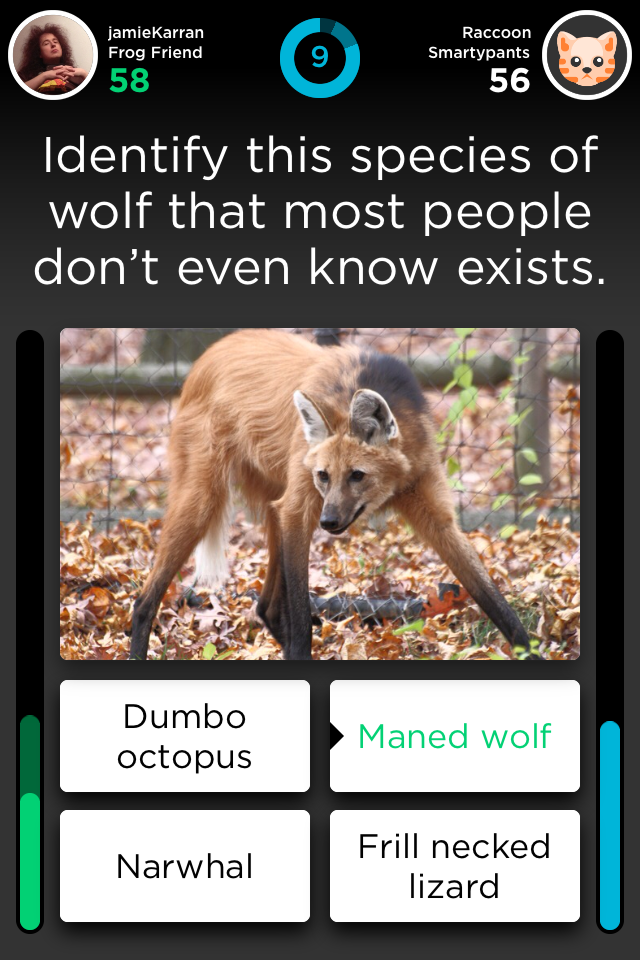
QuizUp is an app (currently exclusive to iOS devices but supposedly coming to Android by the end of the month) on which, you'll be surprised to hear, you can play quizzes. There are of course plenty of apps which let you play quizzes, but this is one of the best I've encountered. It's well implemented, slickly designed, and boasts a colossal number of questions across a truly heroic range of subjects. There are the basics, from simple General Knowledge through Geography, History, Science, etc., to more specific offerings such as Mixed Martial Arts, Woody Allen, and Sex and the City. (Thank heavens for the Oxford comma.) If you fancy mixing a bit of brain training into your quizzing, then you can even dabble in mental arithmetic and word puzzles to keep things fresh.

"If"? Or "When"???
The real selling point, though, is the ease - and speed - with which you can challenge your friends to a test of quizzing mettle. Meanwhile, if your quiz-obsessed lifestyle somehow doesn't leave you time for friends, there are always people from all over the world online to take you on instead. Who knows, maybe there's a hollywood blockbuster waiting to be written about love blossoming from a shared love of Fruits and Vegetables trivia.


The mechanics of the game itself are straightforward. Both players are faced with a series of seven questions, each of which has four possible answers. You get ten seconds to answer and a correct response is worth ten points plus however many seconds you had left (rounded up) on your clock. So if you recognize the flag of the Seychelles in under a second, you'll score the full 20 points, while if you're a bit slower you may drop a point or two that could prove crucial later on. The final question is worth double points, in fairly transparent deference to the quiz show trope of weighting later rounds to minimize the risk of the game being decided early.

Post-game statistics allow for quiet
contemplation (also crying).
I've already alluded to several positives of the app, but on the mechanics of gameplay itself a lovely aspect is that you can see when your opponent 'buzzes in' and whether they've got the question right while you're trying to think. This allows for some mild meta-gaming as you can either put pressure on your opponent with a quick correct answer, or completely eliminate it with a wrong one. A further option is asynchronous play, so if someone isn't online when you want to test their Desperate Housewives knowledge you can do the quiz immediately yourself and they can play the same questions later.

Other more minor features include achievements/challenges (such as attaining a perfect score of 160, or coming back to win after a bad start) and 'titles' you can unlock by levelling up in the various categories. These don't particularly interest me (and the levelling up seems to be a matter of how much time you want to put into the game rather than any sort of ranking system, which is a shame) but are ultimately so peripheral to the game itself that they don't get in the way. The app is constantly updating its repository of questions, too, so if you somehow exhaust the current corpus of questions (spoilers: you won't), new content will likely be just around the corner.

One of my favourite questions in the
history of pretty much everything.
There are, however, some downsides, and for me the biggest one is the fixed game length. Seven multiple choice questions is probably a good number for your typical random game against someone, but among friends I'd really like the option to play much longer rounds. All too often a game is decided by one player's blind guess (a possibility made more likely by the final question's doubled value) which inevitably feels somewhat anticlimactic. A 'custom challenge' mode would, for me, take it from an excellent distraction to a serious quizzing tool. Another limitation is the occasional question whose answer is simply wrong, which is a touch sloppy, but nevertheless forgivable given the game's scale and price.

Otherwise, this is an excellent app, and for the princely sum of £0.00 you really can't go wrong. If you do pick it up, and fancy a challenge, I can be found on there under the name 'Raccoon', while my fellow Only Connect champions exist under the rather more obvious (i.e. boring) Hywel Carver and Jamie Karran. Don't worry if you find yourself addicted though, just call it an investment for future trivia glory (or at least the occasional bit of beer money at your local pub quiz).